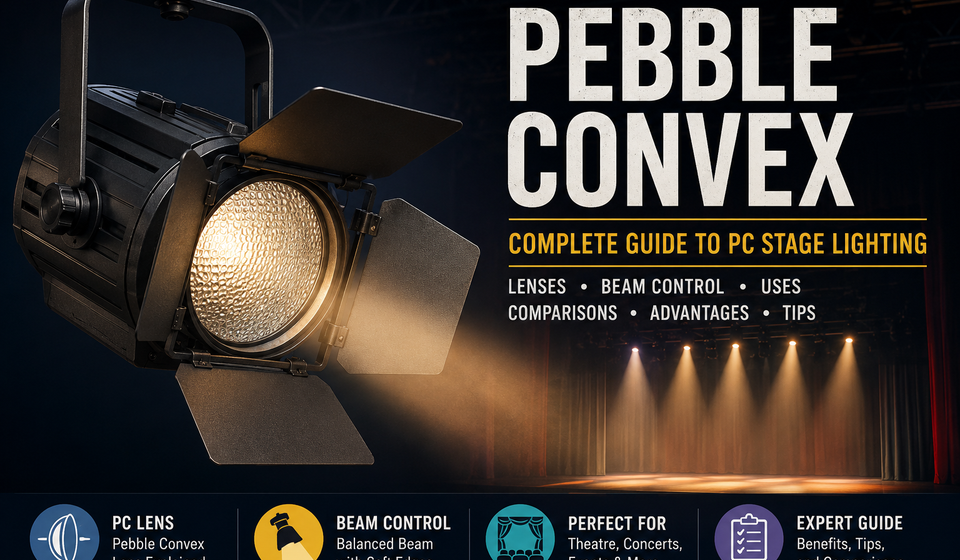

In professional theatre lighting, small differences in lens design can have a major effect on the quality, shape, and control of a beam. One important example is the pebble convex lens, commonly associated with PC or Prism Convex stage lighting fixtures.
A pebble convex fixture occupies a useful middle ground between a Fresnel and a profile spotlight. It can produce a beam with more definition than a typical Fresnel while remaining softer and more forgiving than a hard-edged profile. This makes it useful for front light, side light, backlight, general stage coverage, and situations where lighting designers need controlled blending without an extremely sharp beam edge.
The name refers to the textured or “pebbled” surface incorporated into the flat side of a plano-convex lens. This surface changes how light is distributed and helps soften the optical characteristics of a conventional plano-convex system. Modern PC spotlights commonly use this type of lens.
Whether you are a theatre technician, lighting student, event professional, or simply learning about stage equipment, understanding how a pebble convex lens works makes it easier to choose the right fixture for a particular lighting job.
What Is a Pebble Convex Lens?
A pebble convex lens is a type of plano-convex optical lens with a stippled or textured finish on its flat side. The texture modifies the light passing through the lens, producing a beam that is generally smoother and less prone to some of the optical artifacts associated with a completely smooth plano-convex lens.
In theatre terminology, the resulting fixture is often called a PC spotlight, with PC commonly standing for Pebble Convex or Prism Convex depending on the manufacturer and terminology being used.
The basic concept is straightforward: instead of producing the very soft beam associated with a Fresnel or the sharply defined beam of a profile, the PC fixture provides an intermediate result.
That middle ground is one of its biggest strengths.
How Does Pebble Convex Lighting Work?
A typical PC fixture combines a light source, reflector, lens assembly, housing, focusing mechanism, and often accessories such as barn doors.
The lamp or LED source produces light inside the fixture. The reflector directs that light toward the lens, while the convex optical surface helps shape the outgoing beam.
The textured surface modifies the beam enough to reduce some of the harshness associated with a smooth plano-convex optical system. The result is a controlled pool of light with a relatively defined but not excessively hard edge.
This makes a PC fixture particularly useful when a lighting designer wants more control than a Fresnel provides but does not need the precision of a profile spotlight.
Pebble Convex vs. Fresnel vs. Profile
Understanding the differences between common stage-lighting optics is one of the easiest ways to understand the role of pebble convex equipment.
| Feature | Pebble Convex / PC | Fresnel | Profile |
|---|---|---|---|
| Beam edge | Moderately defined | Soft | Very defined |
| Light quality | Controlled and moderately soft | Soft and diffuse | Sharp and focused |
| Typical use | General stage coverage, front/side light | Washes and broad coverage | Precise highlighting and projection |
| Spill control | Moderate | Relatively broad | Excellent |
| Beam character | Between Fresnel and profile | Soft | Hard |
| Gobos | Generally not the main purpose | No | Commonly supported |
| Best for blending | Good | Excellent | More difficult |
| Precision | Moderate | Low to moderate | High |
A theatre lighting glossary describes pebble convex as having a harder-edged beam than a Fresnel but a softer edge than a profile.
That intermediate character is the defining feature of the design.
Why Is the Pebble Convex Beam Useful?
Stage lighting often requires a balance between softness and control.
A Fresnel can create an attractive soft wash, but its broader light distribution can make precise control more difficult. A profile fixture can provide excellent precision, but its harder beam edge may be inappropriate when a designer wants performers or scenic areas to blend naturally.
The pebble convex approach provides a compromise.
It can produce a broad, useful beam while maintaining more definition than a Fresnel. This makes it suitable for situations where the lighting designer wants an area of light that can be positioned and blended without appearing excessively harsh.
Some theatre-lighting references specifically describe PC fixtures as sitting between Fresnel and profile characteristics.
Common Uses of Pebble Convex Fixtures
Front Lighting
PC fixtures can be useful for illuminating performers from the front when a lighting designer wants reasonably controlled coverage without the extremely sharp appearance of a profile.
The fixture can help provide even illumination while maintaining enough beam definition to manage overlapping sources.
Side Lighting
Side light is frequently used to reveal the shape and movement of performers.
A pebble convex beam can provide controlled side illumination without necessarily producing the extremely hard edge associated with some profile systems.
Backlighting
PC fixtures can also be used as backlights when designers need a defined pool of illumination but do not require projection or gobo functionality.
General Stage Coverage
Because the beam is neither extremely soft nor extremely hard, PC fixtures can be practical for general stage lighting applications.
Theatre and Performance Spaces
Traditional theatre remains one of the most recognizable applications for pebble convex lanterns. PC fixtures have historically been especially common in European theatre lighting.
Concerts and Events
Modern LED fixtures with pebble-convex optics extend the same basic concept into concerts, events, corporate productions, and architectural entertainment applications.
For example, modern fixtures are available with interchangeable Fresnel and pebble-convex lenses, allowing the same lighting platform to produce different beam characteristics.
Pebble Convex and Plano Convex Are Not Exactly the Same
The terms can sometimes cause confusion.
A traditional plano-convex lens has one flat surface and one convex surface. When the flat surface is smooth, the optical behavior can produce a harder and more sharply defined beam.
A pebble convex lens modifies that design by introducing a textured or stippled finish on the planar side.
This texturing helps soften the beam and can reduce unwanted optical effects. Modern PC spotlights commonly use pebble convex lenses rather than the older smooth plano-convex arrangement.
Therefore, although the terms are related, they should not automatically be treated as interchangeable.
What Does “Prism Convex” Mean?
Another term you may encounter is Prism Convex.
The terminology varies between manufacturers and lighting communities. Some theatre references explicitly identify Prism Convex as another name for Pebble Convex.
This means searches for “PC spotlight,” “Prism Convex,” and “Pebble Convex” can sometimes lead to closely related equipment.
However, when buying replacement lenses or accessories, it is important to check the exact fixture model rather than relying only on terminology.
Beam Control and Focus
One of the practical advantages of a PC fixture is the ability to adjust the position or focus of the optical system on many models.
Moving the optical assembly can alter the size and character of the projected beam.
Some modern fixtures also offer interchangeable lenses or different beam-angle options. For example, certain professional lighting systems offer pebble-convex lenses in narrow, medium, and wide configurations.
This provides additional flexibility when the same basic fixture needs to serve different stage positions.
Barn Doors and Spill Control
A lens alone does not determine how controllable a stage light is.
Many PC fixtures can be fitted with barn doors, which are adjustable metal shutters positioned near the front of the fixture.
Barn doors can help shape the illuminated area and reduce unwanted spill onto scenery, curtains, screens, or parts of the stage that should remain dark.
Modern LED PC fixtures continue to use barn-door systems for controlled blending and washlight applications.
Pebble Convex in LED Stage Lighting
Although the concept is strongly associated with traditional theatre lanterns, pebble convex optics are also used in modern LED fixtures.
This combination can provide the familiar PC beam character while taking advantage of LED technology.
Modern LED systems can offer benefits such as lower power consumption, reduced heat output, long source life, colour mixing, digital control, and compatibility with DMX or RDM, depending on the fixture.
For example, professional LED products are available with dedicated pebble-convex optics and RGBW or multi-colour LED sources.
Other modern systems offer interchangeable Fresnel and pebble-convex lenses, allowing users to change the optical character without replacing the entire fixture.
Advantages of Pebble Convex Lighting
1. Balanced Beam Character
The biggest advantage is its position between soft and hard beam types.
2. Useful Stage Coverage
PC fixtures can provide broad coverage while retaining reasonable control.
3. Less Harsh Than a Smooth PC Lens
The textured surface helps soften the optical output compared with a traditional smooth plano-convex arrangement.
4. Good for Blending
The beam can be easier to blend with neighboring fixtures than a sharply defined profile beam.
5. Versatile Application
PC fixtures can be used for front, side, back, and general stage illumination.
6. Available in Modern LED Designs
The optical concept has successfully transitioned into contemporary LED stage equipment.
Limitations of Pebble Convex Fixtures
No lighting fixture is ideal for every application.
A pebble convex fixture may not be the best choice when extremely sharp beam definition is required. A profile fixture is generally more appropriate for precise projection, shutters, and gobo work.
Likewise, if the primary goal is an extremely soft wash with very gentle beam transitions, a Fresnel may be a better option.
PC fixtures also vary considerably between manufacturers. Lens diameter, optical design, source type, beam angle, focus mechanism, and reflector design can all affect the final result.
For that reason, the label “pebble convex” tells you something important about the optical system, but it does not tell you everything about the fixture’s performance.
How to Choose the Right Pebble Convex Fixture
If you are selecting a PC light, consider several factors before purchasing.
Lens Diameter
Larger lenses can be associated with different beam characteristics and fixture designs. Always compare the manufacturer’s photometric information rather than assuming larger automatically means better.
Light Source
Traditional tungsten fixtures and modern LED fixtures behave differently.
LED fixtures may offer lower energy consumption, colour control, digital dimming, and longer source life, while conventional tungsten fixtures have their own familiar colour and dimming characteristics.
Beam Angle
Determine the distance between the fixture and the stage area.
A narrow beam can be useful for longer throws or concentrated coverage, while wider optics may be preferable for shorter distances and broad stage areas.
Control System
For professional productions, check whether the fixture supports the control protocol required by your lighting console, such as DMX or RDM.
Accessories
Check compatibility with barn doors, colour frames, safety accessories, clamps, and other equipment.
Manufacturer Photometrics
Photometric data is much more useful than relying on a product’s wattage alone. Look at beam angle, field angle, output, and throw-distance information when available.
Practical Example: Lighting a Small Theatre Stage
Imagine a small theatre with a stage approximately 8 metres wide.
A lighting designer wants to illuminate actors from the front but does not want the very soft spill of a broad Fresnel wash or the extremely hard edge of a profile.
A PC fixture could provide a useful middle option.
Several fixtures could be positioned at appropriate front-of-house angles and focused toward the acting areas. Barn doors could then be used to reduce spill onto curtains or unwanted scenic areas.
The designer could overlap the beams to create more even coverage while adjusting intensity through the lighting console.
The exact fixture count, lens choice, mounting position, and intensity would depend on the venue and equipment, but the example demonstrates why the intermediate beam character of a pebble convex fixture can be valuable.
Pebble Convex vs. Fresnel: Which Should You Choose?
Choose a Fresnel when you primarily need a soft, broad wash and smooth blending.
Choose a pebble convex when you want more beam definition and control while retaining some softness.
The difference is not simply about brightness. It is primarily about the character and controllability of the light.
A well-designed lighting system may use both types because they solve different problems.
Pebble Convex vs. Profile: Which Is Better?
Neither is universally better.
A profile is the stronger choice for precision. It is designed for controlled beams, sharp edges, shutters, and often gobo projection.
A pebble convex fixture is better suited to general illumination where a moderately controlled, softer beam is desirable.
The right choice depends on the visual goal.
Common Mistakes When Using PC Fixtures
Choosing Based Only on Wattage
A higher wattage does not automatically mean a better fixture. Optical efficiency and beam angle matter greatly.
Ignoring Throw Distance
A fixture that works well at a short distance may not provide the desired coverage from a long throw.
Forgetting Spill
Even a relatively controlled PC beam can illuminate areas that the designer does not want lit. Use appropriate focusing and barn-door adjustment.
Mixing Fixtures Without Testing
Different manufacturers can produce noticeably different beam characteristics even when both products are described as PC or pebble convex.
Ignoring Photometric Data
Whenever possible, compare actual beam and field information instead of relying solely on marketing descriptions.
Maintenance Tips for Pebble Convex Fixtures
Regular maintenance helps preserve both light output and optical quality.
Keep the lens clean and inspect it for scratches, cracks, or other damage. Dust and residue can reduce output and affect the appearance of the beam.
For conventional fixtures, inspect lamps, wiring, ventilation paths, and mechanical components according to the manufacturer’s maintenance instructions.
For LED fixtures, check cooling systems and ventilation because excessive heat can affect electronic components and LED performance.
Always follow the manufacturer’s safety and maintenance procedures, particularly when servicing mains-powered equipment or opening a professional stage-lighting fixture.
Are Pebble Convex Fixtures Still Relevant?
Yes.
Although stage lighting has moved heavily toward LED technology, the underlying optical principles remain useful. Modern manufacturers continue to produce LED fixtures with pebble-convex optics, showing that the beam characteristic still has practical value.
The technology has evolved, but the lighting requirement has not disappeared: designers still need fixtures that sit between broad, soft washes and highly precise hard-edged spots.
That is where pebble convex remains particularly useful.
Frequently Asked Questions About Pebble Convex
1. What is pebble convex?
Pebble convex is a type of stage-lighting lens based on a plano-convex design with a textured or stippled surface. It produces a beam that is generally harder than a Fresnel but softer than a conventional profile beam.
2. What does PC mean in theatre lighting?
PC commonly refers to Pebble Convex or Prism Convex in theatre lighting terminology. It is used to describe a type of spotlight and its associated lens system.
3. Is a pebble convex lens the same as a Fresnel lens?
No. Both can produce relatively soft stage lighting, but their optical designs and beam characteristics differ. A pebble convex generally provides more definition than a Fresnel.
4. Is pebble convex the same as plano convex?
Not exactly. A pebble convex lens is related to the plano-convex design but has a textured surface on the planar side. This texture changes the way the beam behaves.
5. What is a pebble convex spotlight used for?
It can be used for front light, side light, backlight, general stage illumination, theatre productions, concerts, and other applications requiring a moderately controlled beam.
6. Does a pebble convex light produce a hard-edged beam?
Usually not as hard as a profile spotlight. Its beam typically falls between the softer edge of a Fresnel and the sharper edge of a profile.
7. Can pebble convex optics be used with LED fixtures?
Yes. Modern LED fixtures are available with pebble-convex lenses, including systems offering interchangeable Fresnel and PC optics.
8. Can you change a Fresnel into a pebble convex light?
On fixtures designed with interchangeable optics, yes. Some professional lighting systems specifically provide both Fresnel and pebble-convex lens options. However, compatibility depends entirely on the fixture.
9. Are pebble convex lights good for theatre?
Yes. Their balanced beam character makes them useful for many theatre applications, particularly where designers want more control than a Fresnel without the hard precision of a profile.
10. How do I choose between Fresnel, pebble convex, and profile?
Think about beam character. Choose Fresnel for soft washes, pebble convex for moderate definition and controlled coverage, and profile for precise hard-edged illumination and projection.
Conclusion
Pebble convex lighting remains an important part of the stage-lighting vocabulary because it solves a very practical problem: finding a useful balance between softness and control.
Its textured plano-convex lens design produces a beam that generally sits between a Fresnel and a profile. That makes PC fixtures useful for front light, side light, backlight, general stage coverage, and many modern performance applications.
The technology has also adapted to contemporary LED systems, where pebble-convex optics can be combined with colour mixing, digital control, efficient LED sources, and interchangeable lens systems.
For anyone choosing stage equipment, the most important lesson is not simply to look for the words “pebble convex” on a specification sheet. Consider the complete optical system, beam angle, throw distance, output, control options, accessories, and manufacturer’s photometric data.
Used in the right situation, a pebble convex fixture provides a flexible middle ground between a soft wash and a precision spotlight—exactly the kind of balance that makes it valuable to theatre and event lighting designers.


